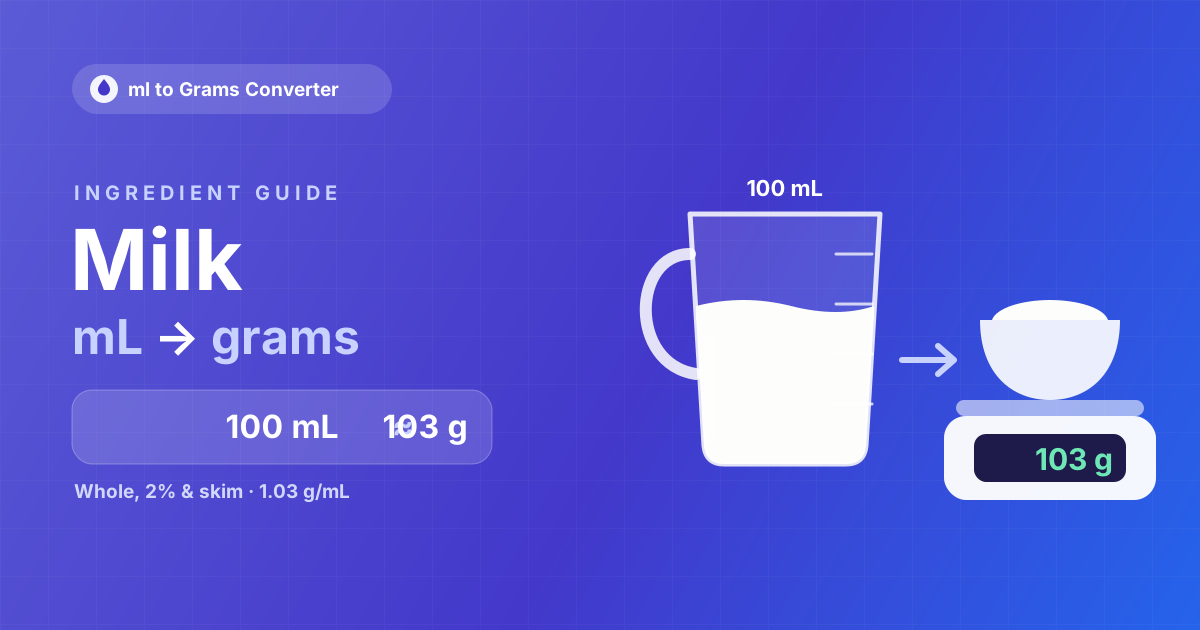
A milliliter of milk weighs about 1.03 g, not 1 g, so 100 mL of milk comes to about 103 g and 250 mL comes to about 258 g. Those figures assume a density of 1.03 g/mL, which covers whole, 2% and skim milk alike. Milk sits very close to water, but mL and grams are still different units: one measures volume, the other measures mass, and milk packs slightly more mass into every milliliter.
Milk mL to grams chart
Use this chart for plain cow’s milk of any fat level, poured as a still liquid. Values under 20 g are rounded to one decimal place; everything above that is rounded to the nearest gram.
| Volume (mL) | Milk (g) |
|---|---|
| 5 mL | 5.2 g |
| 10 mL | 10.3 g |
| 15 mL | 15.5 g |
| 30 mL | 31 g |
| 50 mL | 52 g |
| 60 mL | 62 g |
| 100 mL | 103 g |
| 125 mL | 129 g |
| 150 mL | 155 g |
| 200 mL | 206 g |
| 240 mL | 247 g |
| 250 mL | 258 g |
| 300 mL | 309 g |
| 400 mL | 412 g |
| 500 mL | 515 g |
| 750 mL | 773 g |
| 1,000 mL | 1,030 g |
Density assumption: every value above uses 1.03 g/mL for whole, 2% or skim milk, measured as liquid milk rather than foam. It is the same value the mL to Grams Converter applies when you choose Milk, so the chart and the calculator give matching answers. Real milk varies inside a very narrow band around that figure, and the sections below show exactly how narrow.
Is 100 mL of milk the same as 100 g?
Not quite, and the reason is worth getting straight because it applies to every ingredient. A milliliter measures how much space something takes up. A gram measures how much matter is there. The two numbers only match when a substance has a density of about 1 g/mL, and plain water is the everyday example.
Milk is a little denser than water, so the same volume weighs a little more. Here is the comparison at four common sizes:
| Volume (mL) | Water (g) | Milk (g) |
|---|---|---|
| 100 mL | 100 g | 103 g |
| 250 mL | 250 g | 258 g |
| 500 mL | 500 g | 515 g |
| 1,000 mL | 1,000 g | 1,030 g |
At the size of a small glass the gap is only a few grams. By the time you get to a full liter carton, the milk column reads 1,030 g against 1,000 g for water, so a liter of milk weighs more than a kilogram.
Why milk outweighs water
Milk is mostly water, but it carries dissolved lactose (milk sugar), proteins and minerals, and all of them add mass to each milliliter. Fat pushes in the opposite direction. Milk fat is lighter than water, so the more fat a milk contains, the more it pulls the overall density down. Those two effects nearly cancel, which is why milk lands so close to water, and the solids win by a small margin, which is why it lands slightly above.
In a single recipe you could treat milk as 1 g per mL and never notice. The difference starts to matter when you scale a recipe up, when you are converting a gram-based recipe for a measuring jug, or when you are trying to match numbers on a nutrition label. Treating 1 mL of milk as about 1.03 g keeps your conversions consistent at every size.
Whole, 2% and skim: does the type of milk matter?
Very little. According to the University of Guelph’s Dairy Science and Technology eBook, the density of milk varies within 1027 to 1033 kg/m³ at 20 °C, a narrow range that sits right around the 1.03 g/mL used on this page. The same source gives measured values for three kinds of milk at fridge and room temperature:
| Milk type | At 4.4 °C (fridge) | At 20 °C (room) |
|---|---|---|
| Homogenized whole milk, 3.6% fat | 1.033 g/mL | 1.029 g/mL |
| Producer milk, 4.0% fat | 1.035 g/mL | 1.030 g/mL |
| Skim milk, about 0% fat | 1.036 g/mL | 1.033 g/mL |
Those three-decimal figures come from laboratory measurement. In a home kitchen, the third decimal is far below anything a measuring jug or a household scale can pick up.
Whole milk
Whole milk has the most fat of the common types, so it is the lightest per milliliter, though only just. The Guelph measurement for homogenized whole milk at 3.6% fat is 1.029 g/mL at room temperature. USDA FoodData Central lists one cup of whole milk (3.25% fat) at 244 g, which works out to about 1.03 g/mL. Both sources line up with the converter value.
2% and 1% milk
Reduced-fat milk sits between whole and skim. Taking out some of the fat nudges the density up, but not by enough to show in a recipe: USDA gives 244 g per cup for 2% milk and for 1% milk, the same figure it gives for whole. In the UK the closest equivalent is semi-skimmed milk, which is lower in fat than whole milk but not fat-free, and the same 1.03 g/mL applies.
Skim milk
Skim milk (skimmed milk in the UK) has almost all of its fat removed, which makes it the densest of the plain milks. Guelph measures it at 1.033 g/mL at room temperature, and USDA lists a cup at 245 g against 244 g for whole milk. So yes, skim milk weighs slightly more than whole milk for the same volume.
What the difference means in practice
Across whole, 2% and skim, the spread is under about 0.5%, or roughly 1 g for every 250 mL. That is smaller than the error you get from reading a jug by eye or from a few drops left clinging to the side. Separate charts for each milk would add complication without adding accuracy, so one set of numbers at 1.03 g/mL covers all three.
Cold milk, warm milk and foam
Temperature moves the number even less than fat does. Fridge-cold milk is very slightly denser than room-temperature milk, by about 0.3%, which you can see by comparing the two columns in the Guelph table. For cooking, that is negligible. Measure milk straight from the carton or after it has sat on the counter and the chart above still holds.
If a bread recipe calls for warm milk, the simplest habit is to measure first and warm second. That way you are always measuring the same kind of liquid the chart describes, and you avoid pouring hot milk into a plastic jug.
Foam is the one situation where volume really misleads you. Frothed or whipped milk is full of air, which takes up space but weighs almost nothing, so a jug of foamy milk reads high on volume and low on actual milk. Measure or weigh milk before you froth it.
Milk that has been cooked down and sweetened becomes a very different ingredient. Evaporated and condensed milks have had much of their water removed, so they are far heavier per milliliter. Our sweetened condensed milk mL to grams guide has the numbers for that thicker product, and none of the values on this page should be used for it.
How to convert milk mL to grams
The formula is the same one used for every ingredient: grams = mL × density. For milk that means multiplying by 1.03.
150 mL × 1.03 g/mL = 154.5 g, which rounds to about 155 g.
A handy way to picture it is “the water weight plus about 3%”. For amounts that are not in the chart, enter your volume and select Milk under Milk & Dairy in the mL to Grams Converter to calculate the exact figure.
Milk in spoons and cups
Many recipes still list milk in spoons and cups. These are the gram weights for the measures you are most likely to see:
| Measure | Milk (g) |
|---|---|
| 1 teaspoon (5 mL) | 5.2 g |
| 1 tablespoon (15 mL) | 15.5 g |
| 2 tablespoons (30 mL) | 31 g |
| 1/4 cup (60 mL) | 62 g |
| 1/3 cup (80 mL) | 82 g |
| 1/2 cup (120 mL) | 124 g |
| 2/3 cup (160 mL) | 165 g |
| 3/4 cup (180 mL) | 185 g |
| 1 US cup (240 mL) | 247 g |
| 1 metric cup (250 mL) | 258 g |
Check which cup your recipe means. A US cup is taken here as 240 mL, while a metric cup is 250 mL, and that 10 mL gap is bigger than any difference between types of milk.
You may also see slightly different cup weights elsewhere. USDA’s 244 g figure is based on the US customary cup, which is a little smaller than the rounded 240 mL cup used in this table; both describe the same density. King Arthur Baking lists a cup of milk at 227 g, but that follows a convention of 8 ounces per cup rather than a measured density. It works for their recipes because they were written that way, but it is not what a cup of milk actually weighs.
For small amounts such as a tablespoon of milk in scrambled eggs or a splash in an egg wash, spoons are perfectly accurate enough. Scales earn their place with larger volumes, where small percentage errors turn into real grams.
Worked examples
Each example below uses the same multiplication, so you can follow the pattern with any amount.
Pancake batter with 300 mL of milk
300 mL × 1.03 g/mL = 309 g
If you already weigh the flour for pancakes, weigh the milk into the same bowl. Set the bowl on the scale, tare it to zero, and pour until the display reads about 309 g. That skips the measuring jug entirely.
Bread dough with a metric cup of milk
250 mL × 1.03 g/mL = 257.5 g, which rounds to about 258 g.
Bakers think about dough in terms of liquid to flour by weight. If you pour 250 g of milk when the recipe meant 250 mL, you end up short of the liquid the recipe writer used, and the dough comes out a little stiffer. The reverse table further down shows that 250 g of milk is only about 243 mL.
Custard with 500 mL of milk
500 mL × 1.03 g/mL = 515 g
Custard and pastry cream recipes are often written in grams, and milk is usually the largest ingredient by weight. Halve the recipe and you need 250 mL, which the chart gives as about 258 g.
Stovetop rice pudding with 750 mL of milk
750 mL × 1.03 g/mL = 772.5 g, or about 773 g.
For rice pudding you can put the saucepan itself on the scale, tare it, and pour milk until you reach about 773 g. The same approach suits porridge and overnight oats, where milk and oats are often both given by weight; our rolled oats mL to grams chart covers the dry side of that ratio.
Grams to mL for milk
Going the other way, divide by the density: mL = grams ÷ 1.03. This is useful when a recipe gives milk in grams and you only have a measuring jug.
| Weight (g) | Milk (mL) |
|---|---|
| 10 g | 9.7 mL |
| 25 g | 24 mL |
| 50 g | 49 mL |
| 100 g | 97 mL |
| 150 g | 146 mL |
| 200 g | 194 mL |
| 250 g | 243 mL |
| 300 g | 291 mL |
| 500 g | 485 mL |
| 1,000 g | 971 mL |
Two quick examples show the pattern:
200 g ÷ 1.03 g/mL = 194.17 mL, so fill your jug to about 194 mL.500 g ÷ 1.03 g/mL = 485.44 mL, or about 485 mL.
In each case the volume is a little smaller than the gram figure, because milk is a little denser than water. A kilogram of milk fills only about 971 mL, just short of a liter.
The same logic explains a detail on nutrition labels. Some countries list milk nutrition per 100 mL and others per 100 g, and the two bases differ by about 3%. Since 100 g of milk is about 97 mL, a per-100 g panel describes a slightly smaller pour than a per-100 mL panel. For comparing two cartons that is rarely worth adjusting, but it explains why labels from different countries do not match exactly.
Getting an accurate measurement
Most milk errors come from the measuring, not the maths. A few habits make a bigger difference than any correction for fat or temperature.
- Use a liquid measuring jug, not dry cups. Dry cups have to be filled to the brim, and milk spills or bulges over the rim. A jug with room above the line is easier to fill accurately.
- Read at eye level on a flat surface. Looking down at a jug makes the level seem higher than it is. Crouch so your eye is level with the marking.
- Weigh when the amount is large. For anything from about half a cup up, a scale is quicker and more accurate than a jug. Tare the bowl, pour, and stop at the gram figure from the chart.
- Stick to spoons for tiny amounts. Many household scales only read in whole grams, so a teaspoon of milk is better measured with a teaspoon.
- Measure before frothing or warming. Foam inflates the volume, and hot milk is awkward to handle in a measuring jug.
These numbers are for cow’s milk only. Plant milks such as almond, oat and soy are not covered by this chart, and buttermilk is a separate ingredient too. The converter lists some of them on their own (almond milk at 1.02 g/mL and buttermilk at 1.03 g/mL), so select the matching option rather than Milk. Richer dairy products also behave differently: cream carries far more fat, so see the cream mL to grams guide before you swap cream for milk by weight.
Frequently asked questions
Is 100 mL of milk the same as 100 g?
No. 100 mL of milk weighs about 103 g, because milk has a density of about 1.03 g/mL. Only liquids with a density of about 1 g/mL, such as water, give the same number in mL and grams.
How many grams is 250 mL of milk?
About 258 g, using a density of 1.03 g/mL. The same figure works for whole, 2% and skim milk, because the difference between them is under about 0.5%.
Does skim milk weigh more than whole milk?
Yes, very slightly. Fat is lighter than water, so removing it leaves skim milk a little denser than whole milk, but the gap is too small to matter in a recipe.
How many grams is 1 cup of milk?
A US cup (240 mL) of milk weighs about 247 g, and a metric cup (250 mL) weighs about 258 g. USDA lists 244 g for the slightly smaller US customary cup.
How do I convert grams of milk to mL?
Divide the grams by 1.03. For example, 200 g of milk is about 194 mL, and 500 g of milk is about 485 mL.